 Cui
Cui 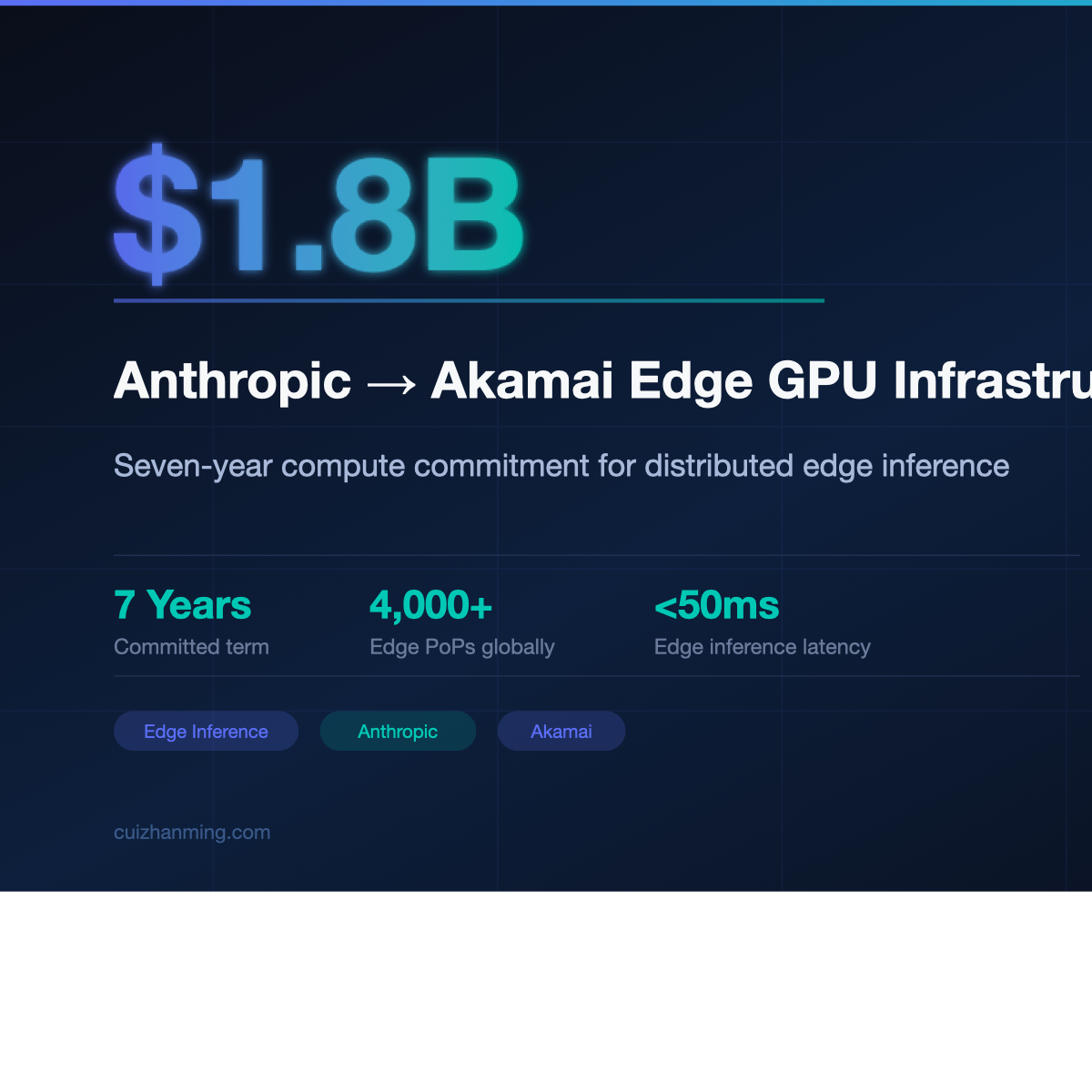
Akamai’s Q1 2026 earnings call dropped a line that deserves more attention than it got.
CEO Tom Leighton: “A leading frontier model provider has committed to $1.8 billion over seven years for CIS, further validating our position as a key infrastructure provider in the AI economy.”
CIS = Cloud Infrastructure Services. The unnamed frontier model provider is almost certainly Anthropic — cross-referenced with Project Glasswing, where Akamai confirmed last week it’s using Claude Mythos to harden its own codebase.
That’s $1.8 billion. Seven years. For GPU compute at the edge.
This isn’t a press release partnership. It’s a balance sheet commitment.
What “Edge” Actually Means Here
Akamai isn’t AWS or Azure. They don’t operate massive centralized data centers. Their entire network is built on distributed edge infrastructure — over 4,000 points of presence globally, designed to put compute close to users.
Their newly launched Akamai Inference Cloud extends this philosophy directly to AI: GPU-powered inference nodes distributed globally, with tight NVIDIA integration, adaptive security baked in, and a positioning statement that cuts to the point:
“Edge Is All You Need”
When Anthropic commits $1.8 billion to this infrastructure, they’re not just buying cheap GPU cycles. They’re betting on a specific architectural thesis: that inference needs to run close to users, not in a handful of hyperscaler regions.
The Project Glasswing Context
One week before these earnings, Akamai published a blog post confirming they’re a participant in Project Glasswing — Anthropic’s initiative that gives critical infrastructure operators access to Claude Mythos, a frontier model built specifically for software logic and vulnerability discovery.
Akamai’s CSO Boaz Gelbord said: “We are testing against critical components in our codebase, with a focus on uncovering previously unidentified vulnerabilities in our environment.”
Two data points that connect:
- Anthropic’s most specialized security model is running inside Akamai’s infrastructure
- Anthropic is committed to spending $1.8 billion on that same infrastructure over the next seven years
This isn’t a vendor relationship. It’s a deep strategic bet — infrastructure access in exchange for Claude’s deployment footprint moving to the edge.
Why $1.8B at the Edge and Not a Hyperscaler?
The obvious question: why Akamai and not AWS/Azure/GCP, where Anthropic already has major relationships?
A few reasons stack up:
Latency arithmetic changes at agentic scale. When Claude is operating as an agent — taking sequential reasoning steps, calling tools, making decisions — each inference hop adds latency. At 200ms per call, a 10-step agentic workflow is 2 seconds of API round-trips. Edge inference collapses that to sub-50ms. Multiply that across millions of users and it’s a qualitatively different product.
Data sovereignty is getting harder to ignore. GDPR, the EU AI Act, sector-specific regulations in finance and healthcare — enterprise customers increasingly can’t route sensitive data to US-based hyperscaler regions. Edge inference, running in-country or in-region, is often the only compliant path for serious deployments.
Akamai’s security posture is a differentiator for AI. Their platform ships with adaptive threat protection, prompt injection defense, and model-aware API security. For enterprises deploying Claude in production, that integrated security layer matters. Anthropic benefits from a hardened delivery network, not just raw compute.
The hyperscaler relationships already exist. Amazon has $4B+ committed, Google/Broadcom have gigawatts of compute. Akamai is additive — a different topology, different latency profile, different geographic reach.
What This Means for the AI Infrastructure Stack
The compute wars are producing an interesting layered architecture:
- Hyperscalers (AWS, Google, Azure): training runs, massive parallel batch inference, model development
- Edge inference providers (Akamai, Cloudflare Workers AI): real-time user-facing inference, <100ms latency requirements, distributed geographic coverage
- Specialized hardware (CoreWeave, Lambda): GPU clusters for mid-scale inference and fine-tuning
Anthropic is now explicitly investing in all three layers. The $1.8B Akamai deal signals that edge inference isn’t a niche use case — it’s a strategic requirement for deploying Claude at scale in production.
For AI Engineers: The Deployment Target Is Shifting
If you’re building Claude-powered systems today assuming all inference routes to api.anthropic.com → AWS us-east-1, you’re building for a constraint set that’s actively being dismantled.
The infrastructure direction from Anthropic is clear: inference everywhere, as close to users and data as the architecture allows.
The $1.8 billion number is just the receipt.
Sources: Akamai Q1 2026 Earnings Release | Akamai Project Glasswing blog | Akamai Inference Cloud
 OpenAI Just Built Palantir: The $4B Deployment Company Explained
Click to load Disqus comments