 Cui
Cui 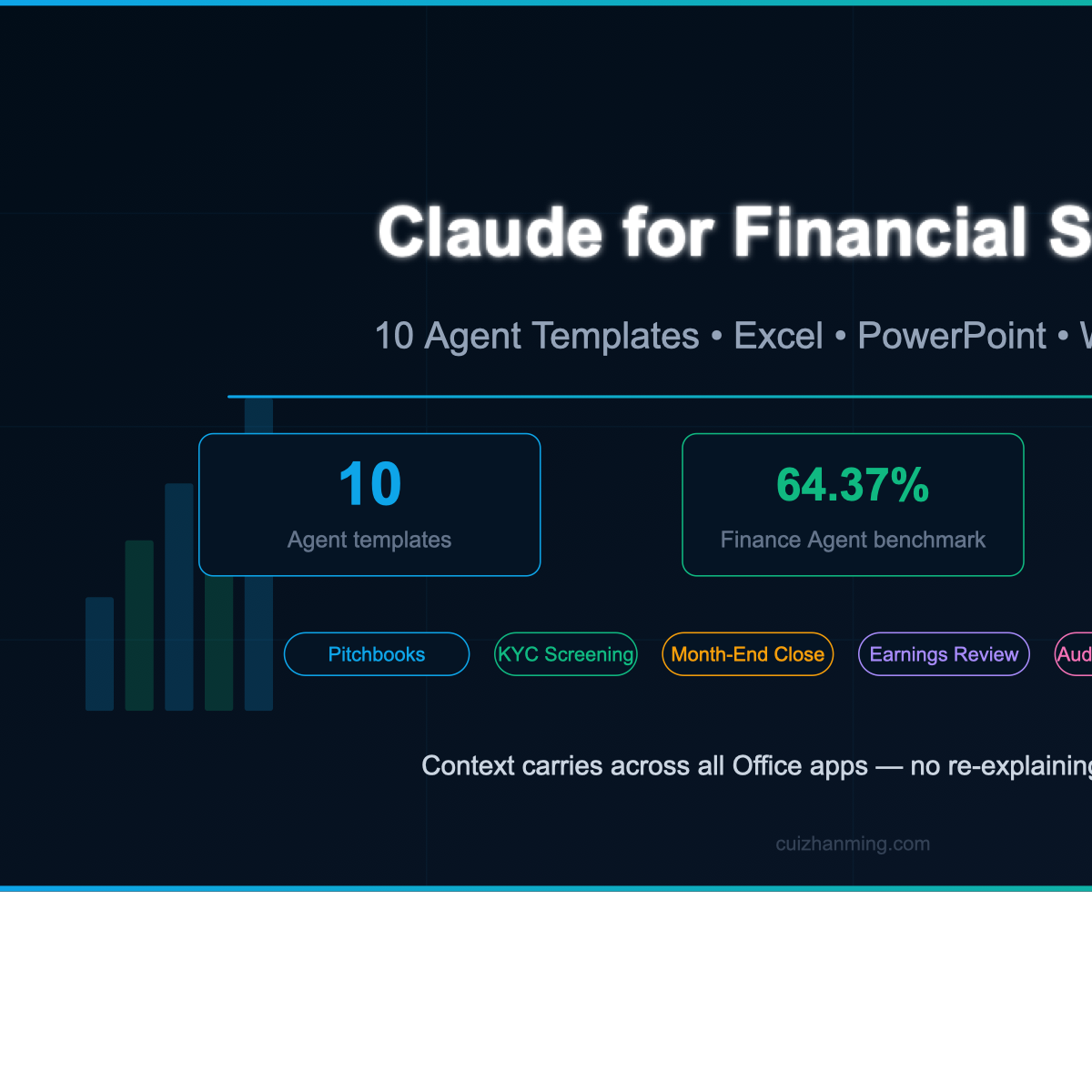
Anthropic just shipped ten ready-to-run agent templates for financial services — and the scope of what these things can handle is broader than the headline suggests.
Pitchbooks built from scratch. KYC files assembled and escalation-packaged. Month-end close checklists run and journal entries prepared. And all of it now works natively inside Excel, PowerPoint, Word, and Outlook via Claude add-ins.
Here’s what landed.
10 Agent Templates, Ready to Deploy
Each template is a self-contained reference architecture: domain-specific skills, governed data connectors, and subagents for specialized subtasks. Firms can adapt them to their own modeling conventions, risk policies, and approval flows without building from scratch.
They break into two buckets:
Research and client coverage:
- Pitch builder — target lists, comparables, full pitchbook drafts for client meetings
- Meeting preparer — client and counterparty briefs assembled ahead of calls
- Earnings reviewer — reads transcripts and filings, updates models, flags thesis-relevant changes
- Model builder — creates and maintains financial models from filings, data feeds, and analyst inputs
- Market researcher — tracks sector and issuer developments, synthesizes news and broker research, flags items for credit and risk review
Finance and operations:
- Valuation reviewer — checks valuations against comparables and the firm’s review standards
- General ledger reconciler — reconciles accounts and runs NAV calculations against books of record
- Month-end closer — runs the close checklist, prepares journal entries, produces close reports
- Statement auditor — reviews financial statements for consistency and audit-readiness
- KYC screener — assembles entity files, reviews source documents, packages escalations for compliance review
Two deployment paths. As a Claude Cowork / Claude Code plugin, templates run alongside the analyst using their existing desktop software — a Pitch agent hands back a comps model in Excel, a pitchbook in PowerPoint, and a cover note ready in Outlook. As a Claude Managed Agent, the same template runs autonomously on the Claude Platform for work that spans a full book of deals or a nightly close schedule — complete with long-running sessions, per-tool permissions, managed credential vaults, and a full audit log in the Claude Console.
Users stay in the loop throughout. Claude drafts; humans review and approve before anything gets filed, sent to a client, or acted on.
The full set is open on GitHub: anthropics/financial-services.
Claude Inside Excel, PowerPoint, Word, and Outlook
This is the piece that changes daily analyst workflows more than the agent templates do.
Claude now runs as a native add-in in all four major Microsoft Office apps. The important design choice: context carries across applications. An analyst who starts a model in Excel doesn’t re-explain it when the work moves to PowerPoint. Claude already knows.
What each add-in can do:
- Excel — builds financial models from filings and data feeds, audits formulas across linked workbooks, runs sensitivity analyses
- PowerPoint — drafts decks that update automatically when the underlying numbers change
- Word — edits credit memos against a firm’s own templates
- Outlook — triages inboxes, arranges meetings, drafts responses in the user’s voice
Outlook is coming soon; the other three are available now.
The Benchmark Number
Claude Opus 4.7 leads Vals AI’s Finance Agent benchmark at 64.37%, which Anthropic positions as the industry-leading score on financial tasks. That’s the model these templates are designed to pair with.
Why This Matters
The individual templates aren’t new ideas — banks and asset managers have been trying to automate pitchbook generation and month-end close for years. What’s new is the packaging: pre-built, deployable, auditable, and integrated directly into the tools people already use.
The Microsoft 365 add-ins are particularly significant because they don’t ask analysts to change their workflows. The model comes to where the work already happens. Combined with context that carries across apps, it removes the biggest friction point: constantly re-explaining what you’re working on when you switch tools.
For firms that have been evaluating AI for finance work from the sidelines, this is a lower-friction entry point than anything available a year ago.
Source: Anthropic announcement
 Anthropic + SpaceX: 220,000 GPUs, Double the Rate Limits, and Orbital Compute
Click to load Disqus comments